
My Brooklyn Saint

With a new car and summer job, my time in New York was supposed to be perfect, at least that’s what my friends and others thought because of my cosmopolitan ways. “You’re going to love New York. It’s so you,” they would say to allay my trepidation of leaving my up south city and going east to bright lights in a real up north city. But this 22-year-old girl from Detroit had real culture shock and homesickness when I smelled the garbage in China Town, saw street mayhem in Times Square, looked for my lost car in Brooklyn, and heard I had to work on Long Island and in Manhattan. I was somewhat petrified. Well, a lot really that I talked about cutting my 10-week internship short by eight weeks. I wanted to go home. Instead I called my praying grandmother—again—and she gave me some scriptures and words of encouragement—again—and I felt better for the moment—again, but I needed something more, someone, and I found her the day I ventured to Bridge Street AME Church.

The members smiled and greeted me after the pastor had visitors to stand and she was among them, Ernestine I’ll call her because I don’t remember her name but I remember her. She wore a brightly colored print bubu and black pants complete with rusty blond hair peeking from under a kufi. Probably in her early 60s, Ernestine gave me a wide smile, strong hug, introduced herself and insisted I call her by her first name. I felt warm and was so glad my fear didn’t cause me to stay at home. But after service, I briefly wished I had. Members hurried about to talk to friends, make dinner plans and serve at church information tables. I glanced about as my pew emptied then gathered my things to leave. As I moved slowly down the pew to the aisle, Ernestine waved to me from among a throng and made her way to invite me to spend the day with her. I readily agreed.

We went to her Brooklyn brownstone before she took me to a street fair and a lecture by the famous historian Dr. John Henrik Clarke. As she changed her clothes, I admired her wood furniture, African carvings and paintings, mahogany fireplace and a picture of her mate. He had passed a few years back, a brief illness I think. Now in a summer sweater with her black slacks, she fixed a snack of peanut butter toast and coffee and told me about her “king.” That’s what I remember. She kept saying, “He was my king!”

In that moment, I knew I wanted a love like hers, to love like her, to be in a place where I had no problem reverencing my man. I wanted sweet times and golden memories that would make me shriek “he is my king.” And I have that now, due in large part to Ernestine, a woman confident in her femininity, comfortable with her Christianity and African culture and the strength of her man where she didn’t mind calling him her king.

In New York I did come to love Chinese food delivery, hanging out in the Village and on Harlem’s 125th Street, and going to Junior’s on Brooklyn’s Atlantic and Flatbush. But above all I loved a woman whose name escapes me but the memory of her love for life and her man will remain with me forever.

Copyright 2010 by Rhonda J. Smith
Free to Love

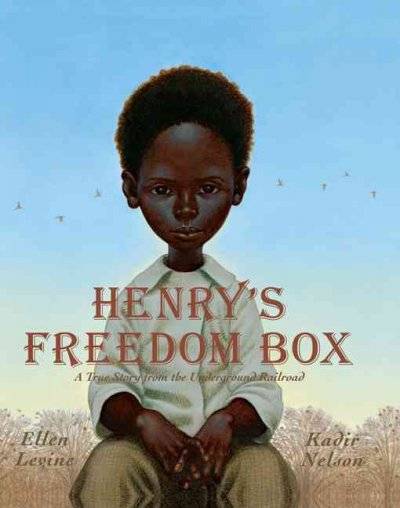
Henry's Freedom Box by Ellen Levine

Today I write about not who I thought I would but about Henry “Box” Brown, one of the most famous runaway slaves of the Underground Railroad because he mailed himself to freedom. Henry has been on my mind because of a statement an old acquaintance made when she found out I was a stay at home mom. Referring to her brief time off with her child, she said, “I was bored. I didn’t know what to do.” I told her that I had heard that before. With others the statement had been apologetic as if the women were sorry they didn’t have the stamina to hold their post at home. But there were no apologies with this woman. With a raised eyebrow, the squint of the opposite eye, and the slow shake of her head, she said, “Go ahead. I couldn’t do it.” Then I thought about Henry and his mom and how they would have loved to be in this woman’s place.

As a boy in the early 1800s, Henry’s master took him from his mother and gave Henry to work as a slave for his son. Henry eventually married and had children, who all were sold away from him. His heart ached for his loved ones but he realized he wouldn’t see them anymore. With the help of friends, including a white abolitionist, Henry decided to ship himself to freedom. He got into a box and mailed himself from Virginia to Pennsylvania. In 1849 he was free from slavery but neither he nor his mom was free to be with their children, something they longed to do. Now I’m sure if my acquaintance had her children stolen from her, her heart would ache and she would fight to get them back, but her attitude conveyed an unwillingness to care for her them in a hard place. And I imagine there are few harder places to care for children than in slavery.

Joshua, 7, has a mouth that moves more than his busy body. And Nathaniel, 2, grabs and seeks to destroy everything in his sight. And Justus, 3 months, needs me for everything. Yes, my children are a challenge, but I’m so glad I can hold them, be around to scold them and to pour into them my values most of the day. Henry didn’t have that. Neither did his mom or wife or thousands of other enslaved Africans. Henry is my hero and so are the other men and women whose families were torn apart but they didn’t fall apart completely. They kept on because they chose to. And we get tripped up over some crying, demanding children who God has granted us favor to have. They weren’t sold or swindled from us like some Haitian children whose parents believed would have a better life if they gave them over to an agency that promised that. I hope we reassess our attitude toward being with our children and are grateful for the privilege to care for them, even in the hard places.

Copyright 2010 by Rhonda J. Smith

Let's Celebrate Black History

Let’s Celebrate!

It’s Black History Month. I’m black and I want to celebrate that aspect of me. I try to do it all the time, not by being over the top about it but giving a proper due to those of my hue. Some Christians don’t think race should be an issue at all. They cite Galatians 3:28. This scripture doesn’t dismiss race but affirms that all races, genders and nationalities in Christ are equal. Even though some use this scripture to say we shouldn’t celebrate blacks’ contribution to society by noting their race, I use this scripture to say the opposite. Because blacks and their works have been consistently, systematically even, marginalized throughout the decades, and because God looks at Christians the same regardless of race, I believe I am obligated to highlight black Christians. But I won’t just celebrate them but also some of my heroes in the secular world because of their biblical ideas, even if they didn’t acknowledge the Bible; truth is truth and all comes from God. Won’t you celebrate with me?

Copyright 2010 by Rhonda J. Smith

Operation: Refocus

    “For I do not do the good I want, but the evil I do not want is what I keep on doing” (Romans 7:19).

Paul capsulized what every Christian feels like when they are struggling to do good. As we struggle, let’s get some mental incentive: Due season may not come if we don’t give due diligence.

If ye walk in my statutes, and keep my commandments, and do them; Then I will give you rain in due season, and the land shall yield her increase, and the trees of the field shall yield their fruit(Leviticus 26:1-4).

After reminding them who He was and how they were to relate to Him, God told the Israelites to follow His procedures (statutes), be ready to obey his laws (keep my commandments) and actually do them and then He would give what was needed (rain) at the right time (due season) so they could receive a great harvest.

The good we do must flow from the pages of Scripture, and I believe the beginning of doing good is what He told the Israelites, summed up here: in order to follow the way of God, you must focus on the will and way of God, and then perform the will of God. God has certain ways He wants us to do obey and we can only accomplish His will if we focus on it and how He tells us to do it. There is no room for delayed obedience, partial obedience or reworked obedience (figuring out how to accomplish what God said in the way we want to do it). Due diligence to God’s words must precede due season. But even knowing this, struggle may still be in our sight. We must refocus to help us focus on the right thing.

Thank God that Paul tells us in Romans 8 that we can succeed if we focus on the Holy Spirit and not on our flesh. The Holy Spirit gives us the power to give due diligence, thus planting a seed for our harvest in due season.

Copyright 2010 by Rhonda J. Smith

Due Season

It’s only January, maybe too early for some of you to be discouraged about reaching your goals so let me give you a word of caution so you won’t go there:

God’s timing depends largely on our obedience.

I say God’s timing because what we are working toward may not be His will for our lives (1 John 5:14-15). And I say largely because God is sovereign; he can do what He wants when He wants (Psalm 115:3), but His word does promise certain outcomes based on our behavior. Galatians 6:9 speaks to our obedience and God’s timing: “And let us not be weary in well doing: for in due season we shall reap, if we faint not.” We are commanded not to get weary (“to be utterly spiritless”; “exhausted”) when we are doing something good because eventually we will see benefits from our work. But we will only see these benefits in due season: when God deems the right time to be.

Galatians 6:9 is something that we need to keep in mind as we plug away at a tough job, continually discipline hard-headed kids, seek to fulfill those New Year’s resolutions, or mend a relationship with an old friend. God’s timing largely depends on our obedience. If we are being obedient, we just have to wait on God. He will bring us good in due season.

Copyright 2010 by Rhonda J. Smith