Interpretating The Making of Unforgiveness

You may have read something about or heard someone describe just how you were feeling, but you just never had the words to express your emotions. This was the reaction to many women in my workshops on forgiveness. They saw their stories in the poem The Making of Unforgiveness. As they examined the poem, they uncovered its meaning and were able to make the message even more personal. I have challenged you to do the same. Perhaps you didn’t because you weren’t quite sure of my poem’s interpretation. Let me share with you what the women gained.

They understood that if you are on the defense you will expect people to offend you and allow the offense to negatively impact you. You will harbor anger toward them and not seek to reconcile with your offenders. As a result, you have deep-seated anger that turns to bitterness which deepens with every subsequent act that you tally but fail to address for reconciliation. You get used to the bitterness and believe that it somehow protects you from pain or any other attack from your offenders. The bitterness takes over your soul and threatens every relationship. This is what The Making of Unforgiveness is all about.

Do you want to live life on the defense? Do you want to be assured that you will negatively impact people? Do you want a series of broken relationships? Do you want a poisoned soul that sours your attitude and prevents you from showing love? Do you want to keep seeking illusive protection under the tree of unforgiveness? I don’t think anyone who wants a whole life would say yes to any of these questions. But when we don’t seek forgiveness we are saying yes to each. This is why choosing forgiveness is necessary. Today is a new day. Choose forgiveness. In doing so, you choose a new life, one that is guided and protected by an all-powerful, all-knowing and all-seeing God. When you choose forgiveness you choose access to the almighty God and reconciliation and peace that can only come from Him.

Copyright 2010 by Rhonda J. Smith
The Necessity of Forgiveness

Many said it was hard. Others admitted they didn’t want to do it. Some didn’t think they could do it. But most knew that they had no choice but to forgive. These were the women in my workshops on forgiveness last weekend. They challenged my ‘no exceptions’ message by saying surely murderers and pedophiles didn’t apply. After I reiterated that no sin we could do to each other was greater than our sin against a perfect God who died so our sins wouldn’t be charged to us—thus offering us forgiveness, they understood that even murderers and pedophiles must be forgiven (Mark 3:28).

Understand this: Just because you forgive—no longer being angry and criticizing—doesn’t mean you validate the offender’s sin. Forgiveness doesn’t necessarily cancel the consequences for the sin either (i.e., pedophiles must register as sex offenders and not be allowed to interact with children though they may “deserve” death). Forgiveness is a set of actions toward the offender to help her turn from her ferocious or violent behavior (Luke 6:27-37 & 17:3*). Christians are deliverance agents sent on a mission from God to reconcile people to Him. Forgiveness is but one method that God uses.

Forgiveness is not only used to heal the offender but also the offended (the ones directly affected and those offended by what was done to others). Until we forgive, our soul (mind, will and emotions) will be tormented (Matthew 18:15, 34-35). There will be no peace, even though we may have moments of happiness based on circumstances in our life, things that happen outside of us. Our inside, where stability comes from, will still be a wreck if we withhold forgiveness. We may not have daily manifestations of anger and pain, but unforgiveness works in concert with anger and pain, leading us to bitterness and an eventual outburst that will damage others (Hebrews 12:15). We must also forgive others so that God forgives us (Matthew 6:14-15).

The women in my workshops began to understand that unforgiveness creates fractured relationships and fractured souls. As Christians, we are called to be in fellowship with God and one another. We are also called to minister the love, grace and healing of our Lord and Savior Jesus Christ so that others’ might have a personal relationship with Him and be whole. Forgiveness calls for us to take our eyes off the offense and focus on loving the hell out of the offender. Each act of love serves to push the offense from the forefront of our minds. The more acts of love we offer the farther away the offense becomes. Again, forgiveness is not easy, but it is necessary for the welfare of all and for the kingdom of God.

So those of you who are withholding forgiveness, I continue to challenge you: Rewrite The Making of Unforgiving (also see Activate Forgiveness) to help you face your offender and the offense, not to relive the moment but to begin the process toward forgiveness.

Copyright 2010 by Rhonda J. Smith

*Greek definition of rebuke

Activate Healing

Forgiving others can be hard, but the act is necessary. Notice that I said act because forgiving is not words we say but actions we perform. But before speaking to or doing for another, we must acknowledge that we have an issue with that person. Doing this can be hard for everyone, including traditional strong black women who tend to ignore pains inflicted on us; our lives are so full of activities that we may think we don’t have time to stop to deal with someone who has offended us. Or maybe we don’t want to admit that someone hurt our feelings because doing so makes us look weak. And perhaps we think being vulnerable is not a position we can afford to be in.

Well, we must risk missing a deadline and being vulnerable so that we make amends. This is for our health and the health of others. In keeping with my observance of National Poetry Month, I posted the poem The Making of Unforgiveness on Friday. On Saturday I ministered at a women’s retreat on the topic of forgiveness. In one exercise I had the women rewrite this poem to reflect someone who they hadn’t forgiven. I had them title their poem My Making of Unforgiveness. The women began to unearth things, many they had buried years ago. By their own admission, through this exercise many women began to heal. I challenge you to rewrite the poem to fit your situation and let me know the effect the process has on you. I look forward to hearing from you.

Copyright 2010 by Rhonda J. Smith

The Making of Unforgiveness

He hurled them toward me
and I stood in their way
feeling the impact with more force than even he intended.
I hate those words, meddling words, lying ones, any ones spit from his tongue that hit me and don’t meet my approval.
But I stood in their way, let them penetrate to create a tree of unforgiveness in me.
This hurling, embracing and planting happened the first time.
This hurling, embracing and watering happened the second time
And the third
The fourth
And fifth.
The tree never missed a good watering.
It’s well rooted.
It stands tall.
Its blossoms are pretty to me.
It looms and stands strong in my soul.

Copyright 2010 by Rhonda J. Smith

My Literary Love

For about two years I carried a postcard of his picture with me. His serious look reminded me of a serious guy I was enamored with and dated for a bit back in college. But Henry began to make Jerard look like a wimp. Jerard was an unsure writer of some articles and a few poems, had attended prep school and was trying to get settled for his future. He was mostly diligent, a little quirky and he adored me, at least most days. I thought he’d be a good husband, but I kept thinking of Henry, perfect Henry and comparing Jerard to Henry. Henry was a man on a seemingly self-imposed mission, and I liked that and fell in love.

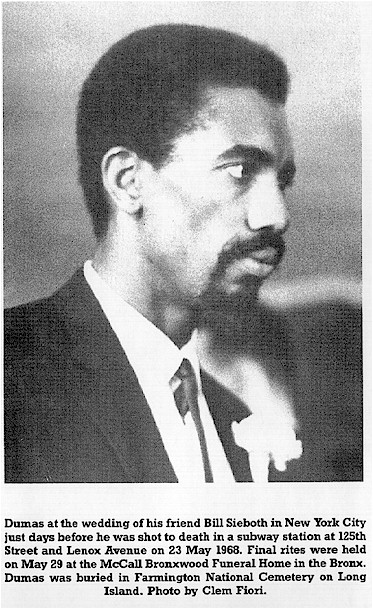
Henry Lee Dumas, my literary love


Continue reading